Scene
What the person sees.
Chest- or head-mounted capture records 3D workspace context, tools, surfaces, and obstacles.
The WELL is TRACE's data layer for embodied AI: real human task sessions captured outside the lab, validated before use, and structured so contributors can participate in the value they create.
Pipeline
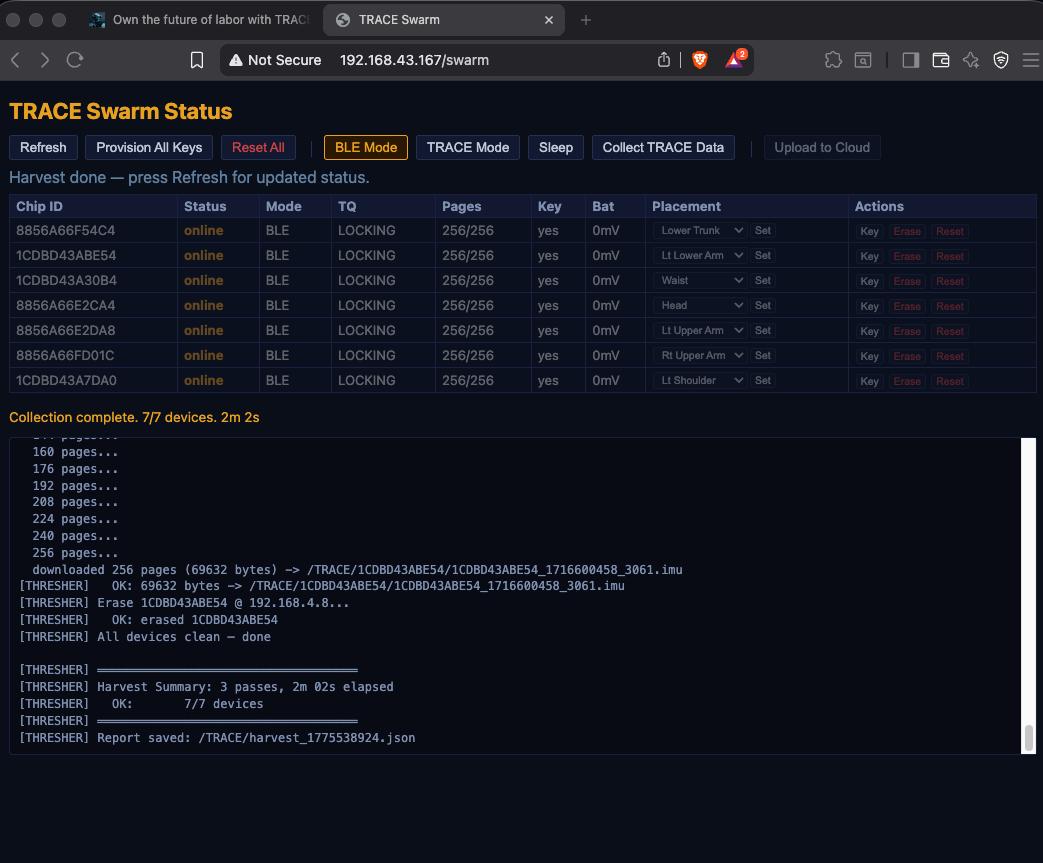
Swarm collection and harvest tooling gives TRACE a practical path from field capture to validated inventory.
Raw
signal first
Preserve motion, scene, timing, audio, and context before narrow labels.
Gated
entry path
Sessions must pass sync, quality, consent, and fraud checks.
Aligned
contributors
Verified hours can participate in downstream commercial value.
Licensed
deployment
Research access can be open while production use stays licensed.
Why it exists
Text and images were captured at scale; the physical record of human work was not — body motion, scene context, tools, timing, proximity, and cooperation. The WELL makes that record available without pretending real-world capture is easy.
Scene
Chest- or head-mounted capture records 3D workspace context, tools, surfaces, and obstacles.
Motion
A wearable sensor swarm tracks reach, turn, lift, step, pause, and handoff patterns that video alone can miss.
Timing
Synced streams turn ordinary sessions into useful sequences: before, during, after, and between task moments.
Sound
Synchronized audio carries spoken instructions, a warning versus a comment, an approaching vehicle, or the shatter of a dropped glass — physical events vision misses.
Inside a session
Each session is a bundle of synchronized streams — sampled fast, stored at working rates, and aligned to the millisecond so a model can learn how they move together.
One session, every stream aligned to the millisecond. Illustrative layout, not real capture.
| Stream | Captures | Sampled | Stored |
|---|---|---|---|
| Body motion (IMU) | Accelerometer + gyroscope across the worn sensor swarm | 240 Hz | 50 Hz |
| Magnetometer | Magnetic heading and orientation reference | 240 Hz | 10 Hz |
| Context video | Wide-angle RGB scene | — | 10 Hz |
| Depth (dToF) | 48×32 time-of-flight depth map | — | 10 Hz |
| Barometric | Pressure and altitude context | — | 10 Hz |
| Audio | High-fidelity voices and environmental sound | — | continuous |
Sampled rate shown where it exceeds the stored rate — inertial streams are oversampled and quantized down. All streams share one clock.
Inventory path
TRACE runs the WELL as managed infrastructure. The data path moves from capture to validation to packaging to licensing, with contributor accounting connected along the way.
Task capture
Data review
Labeling & grading
The WELL
Model training
Every uploaded hour moves through quality grading, fraud detection, consent-aware capture settings, and contributor accounting before it can enter the WELL.
01
Contributors record eligible work with a configured MMT core and body-worn sensors.
02
TRACE checks session integrity, signal completeness, capture mode, sync, and fraud signals.
03
Useful sessions become dataset inventory with task metadata, quality grading, and access constraints.
04
Researchers and builders access the right data products under terms that fit research or deployment.
Governance
Real-world task data is powerful because it is real. That also means privacy, quality, consent, and fraud cannot be bolted on later.
Quality
The WELL should be smaller and more trustworthy before it is merely bigger. Useful data has sync, context, coverage, and task value.
Consent
Capture modes, contributor guidance, and local consent responsibilities are part of the data product rather than an afterthought.
Accounting
Contributor economics only make sense if TRACE can connect accepted sessions to the people who produced them.
Why it compounds
01
Growing dataset
Each recorded hour makes every earlier hour worth more.
02
Research adoption
Free for researchers — their published work pulls in commercial teams.
03
Commercial licensing
Deployment fees flow back to TRACE and the people who built the data.
04
Contributor incentives
Contributors earn for as long as the data earns — so they keep producing.
The wearable can be copied. The aligned contributor network, governed corpus, licensing framework, and processing pipeline are much harder to recreate once they start reinforcing each other.
Dataset examples
The WELL starts where robots are weakest: normal physical work, shared spaces, and messy human timing.
Access
The access model separates exploratory research from commercial use. That keeps the research path useful while preserving licensing, contributor accounting, and dataset integrity.
Research
The research path is meant for embodied AI teams exploring physical behavior, data mixtures, policy learning, and evaluation.
Contribution
The contributor path turns eligible work sessions into validated, licensable inventory after quality review.
Build the data layer
The next step is matching contributors and researchers to the right access path, then growing validated sessions into useful dataset inventory.